The first three groups in our main guide, 18 buying signals that show a company is about to change IT providers, come from what firms do. This page covers the fourth group, what owners say in public.
What owners say in public is a buying-signal group for IT providers built from four sources. First, owners on the record: a managing partner describes a technology problem on a podcast or recorded webinar, which gives an outbound team a firm, a quote, and a date. Second, forums and social posts, where owners and IT managers describe pain in their own words. Most posts are anonymous, so this source improves message copy more than it grows a list. A named firm posting publicly moves to the top. Third, AI mistakes in local courts: public rulings on fabricated AI citations give a dated reason to offer every other firm in that county a governed AI setup, without naming the lawyer involved. Fourth, silence on AI among regulated advisers: a firm that discloses no meaningful AI use while examiners ask about AI policies, vendor oversight, and training is a candidate for an exam-readiness conversation. These signals are low volume and highly specific, so they sit at the top of a list rather than replacing it.
Everything in this group is gathered within each platform's rules, by people reading, not by scraping.
1. Owners on the record
Managing partners sit on industry podcasts and recorded webinars. One of them says the thing an IT provider needs to hear: "our document system is a mess."
That is a signal with three parts: the firm, the quote, and the date. An owner who says a problem out loud has already decided it is a problem.
By hand this is slow, because nobody on an MSP sales team can listen to every regional business podcast. An outbound system can watch for these mentions and hand the sales lead a quote and a link. The first message quotes the owner's own words back, with the episode date, and asks whether the problem is still open.
2. Forums and social posts
Owners and IT managers describe pain in their own words in the places they talk shop: professional forums, industry groups, and social posts. A firm whose staff complain about IT in public has usually already lost patience with whoever runs it. By hand this is slow because nobody can read every forum and group where owners in a territory talk shop.
Most of these posts are anonymous, so you usually cannot email the poster. What you get is the buyer's vocabulary: the exact phrase they use for the problem, the one that earns a reply in your first line. This source feeds message copy more than list volume.
The exception is the named firm. When someone posts under a real name at a real company, describing a real problem, that account goes to the top of the list.
3. AI mistakes in local courts
Courts are catching filings that cite cases which do not exist, produced by generative AI and never checked. Judges have answered with public rulings and, in many courts, standing orders (rules a judge sets for every case in that court) that require lawyers to verify every citation. The State Bar of California's guidance on generative AI names the risk: tools that produce "plausible but inaccurate information, including purported citations to legal authority that does not exist."
Each ruling is public, dated, and local, which gives an IT provider a reason to talk to every other firm in that county about a governed AI setup: approved tools on a company account, retention settings, an acceptable-use policy, and training. ABA Formal Opinion 512 says firm managers must set clear policies on permissible use of these tools and train their people. By hand this is slow because nobody reads every ruling in every county courthouse.
One rule, with no exceptions: never name the lawyer involved. The ruling is the reason; the person is not the pitch.
4. Silence on AI among regulated advisers
Registered investment advisers (firms that manage money for clients and register with the SEC or a state regulator) file public disclosures. A firm that discloses no meaningful AI use, while examiners have said they will look at AI policies, is the one to write to.
The SEC Division of Examinations' fiscal year 2026 priorities say the Division will "assess whether firms have implemented adequate policies and procedures to monitor and/or supervise their use of AI technologies," and will look at training and security controls against AI-related risks. The same document points to oversight of third-party vendors under Regulation S-P (the SEC's customer-data privacy and safeguards rule), whose 2024 amendments require a written incident response program.
For an IT provider, that turns silence into a conversation: "Your next exam may ask how you supervise AI use, which vendors touch client data, and whether staff were trained. Can you show all three?" An adviser with none of those is worth a conversation. By hand this is slow because nobody reads every adviser's public disclosure filing and notices what it leaves out.
5. Using what owners say: message copy versus list volume
The first three signal groups mostly grow a list. This group sharpens a message. A named owner, a named firm, and a court ruling in a specific county each produce a few accounts and a specific reason to write. Those go to the top of the list.
An anonymous forum thread produces no account, only a sentence. That sentence goes into the copy for the whole segment: the subject line, the first line, the question at the end.
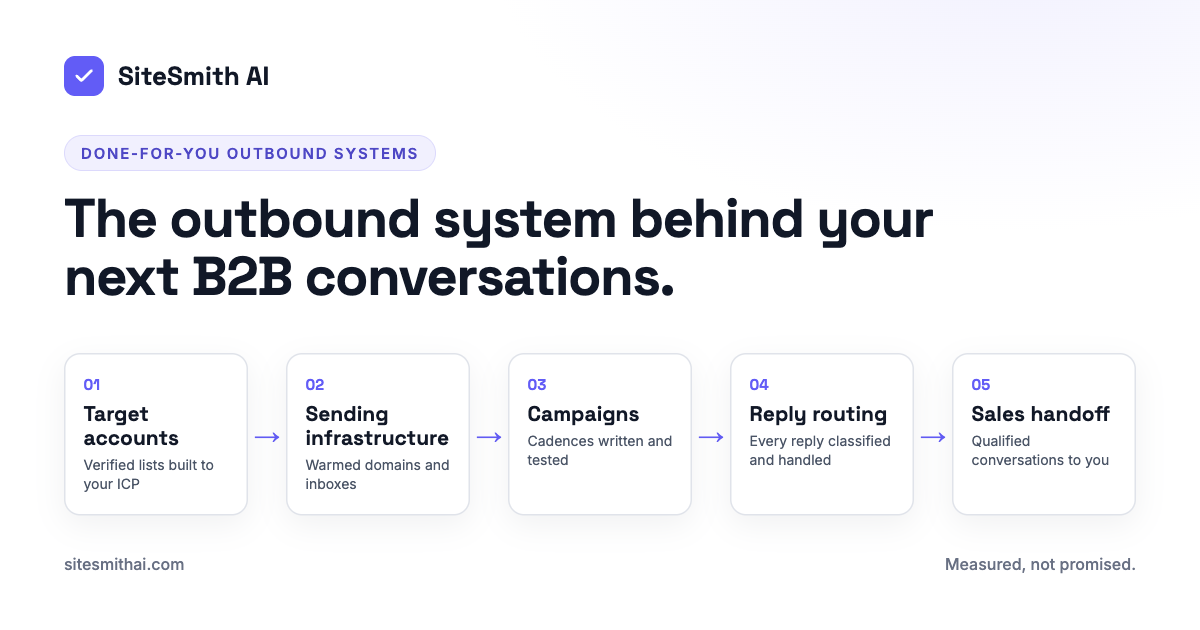
SiteSmith builds target lists around signals like these, with the named accounts at the top and the buyer's language in the copy. Neither replaces the base list built to your ideal-client definition.
6. Two caveats
First, nobody buys the day the event happens. Follow-up runs over weeks, not once.
Second, the sharpest signals are low volume. In any territory, few managing partners say a technology problem out loud. These accounts sit at the top of a list built to the MSP's ideal-client definition. They are not the whole list.
Where to go from here
The public-records group is the natural companion to this one: see filings and public records that predict an IT decision. To turn a signal into a first message and a sales handoff, read how to build an MSP outbound system.
Sources and editorial note
SiteSmith publishes practical operating guidance and cites external sources for factual industry and security claims. This article is not legal, regulatory, or cybersecurity advice.
- SEC Division of Examinations, Fiscal Year 2026 Examination Priorities (PDF)
- SEC, press release on the 2024 amendments to Regulation S-P
- ABA Formal Opinion 512, Generative Artificial Intelligence Tools (PDF copy hosted by LawNext)
- State Bar of California, Practical Guidance for the Use of Generative Artificial Intelligence in the Practice of Law (PDF)
- UNC Kathrine R. Everett Law Library, Judicial Guidance on the Use of GenAI in Court